

When acquiring real estate, Dutch real estate transfer tax (RETT) is often payable, and in some cases value added tax (VAT) as well. This is not limited to purchasing a home or commercial building. The acquisition of economic ownership and the acquisition of shares in a real estate company may also trigger real estate transfer tax.
In this article, I discuss the principal rules on real estate transfer tax, including the taxable amount, the rates, acquisitions of shares in a real estate company qualifying as an *onroerendezaakrechtspersoon* (OZR), the six-month rule and the main exemptions.
Contents
- What is real estate transfer tax?
1.1 Economic ownership
1.2 Shares in a real estate company (OZR)
- What is the taxable amount?
2.1 The six-month rule
- Which rates apply in 2026?
3.1 First-time buyer exemption: 0%
3.2 The 2% rate
3.3 The 8% rate
3.4 The 10.4% rate
3.5 The 4% rate for certain OZR acquisitions
- Which exemptions are available?
4.1 VAT/real estate transfer tax concurrent taxation exemption
4.2 Transfer of a business within the family
4.3 Other exemptions
- How is real estate transfer tax collected and who is liable?
1. What is real estate transfer tax?
Real estate transfer tax is levied on the acquisition of immovable property situated in the Netherlands, or limited rights in such property (such as usufruct, easements, rights of superficies and long leasehold rights).
Real estate transfer tax is also payable on the acquisition of economic ownership of immovable property.
1.1 Economic ownership
An acquisition of economic ownership occurs when the following five cumulative conditions are met:
- A combination of rights and obligations has been acquired.
- That combination relates to immovable property or rights to which such property is subject.
- The combination entails at least some exposure to changes in the value of that property or those rights.
- The exposure to changes in value rests with a person other than the legal owner or holder of the limited right.
- The acquisition involves more than merely the right to delivery.
The fifth criterion deserves particular attention. The State Secretary of Finance has approved that the alternative system of purchase and conveyance does not constitute an acquisition of economic ownership. This alternative system is used by civil-law notaries in particular circumstances. Under it, conveyance takes place through the purchase and conveyance deed subject to a condition precedent, including payment of the purchase price.[1] On signing that deed, the purchaser acquires an interest in the immovable property. However, the actual risk remains with the seller until the deed acknowledging receipt and discharge is signed. If the parties enter into additional agreements concerning purchase and conveyance, such as an early-access or key-handover agreement (*sleutelverklaring*), there is an acquisition of economic ownership that is subject to tax. The State Secretary has, however, also confirmed that the reduced transfer tax rate may apply where the purchaser is allowed to use and renovate the home under such a key-handover agreement before acquiring legal ownership, and subsequently obtains legal ownership.[2]
Acquiring an option to purchase immovable property is, in principle, not taxable, because according to the State Secretary the option gives the option holder a right but not an obligation.[3]
[1] Decree of 23 April 2021, no. 2021-64140.
[2] Decree of the State Secretary of Finance of 2 March 2023, 2023-2, Government Gazette 2023, 5423.
[3] Parliamentary Papers II 1994/95, 24 172, no. 10, p. 3, V-N 1995, p. 3368; Parliamentary Papers II 1994/95, 24 172, no. 3, p. 24, V-N 1995, p. 3517.
1.2 Shares in a real estate company (OZR)
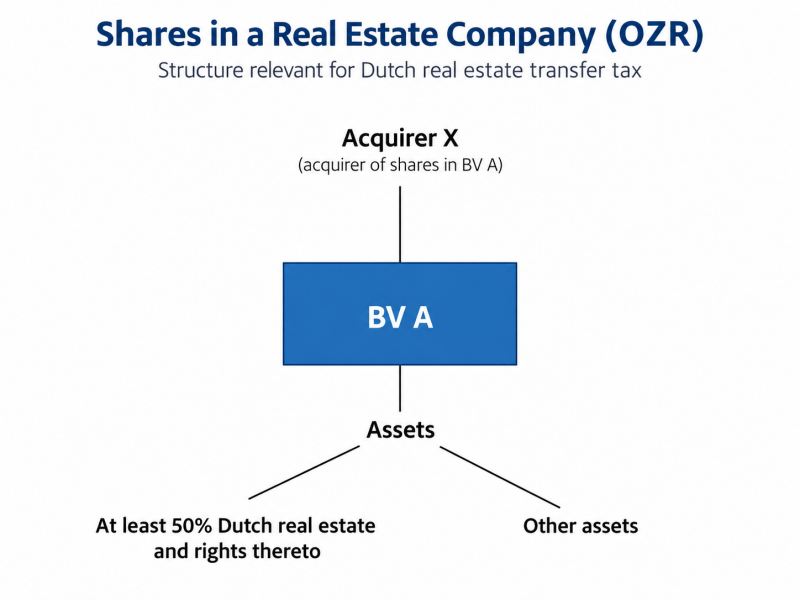
Shares in a qualifying real estate company (*onroerendezaakrechtspersoon*, OZR) are deemed to be immovable property (‘deemed immovable property’). Consequently, an acquisition of deemed immovable property is also subject to real estate transfer tax, provided that the acquisition qualifies. The rationale is, of course, that otherwise real estate transfer tax could easily be avoided by placing real estate in a private limited company (BV).
**When does a company qualify as an OZR?**
A legal entity qualifies as an OZR if it meets two cumulative tests:
- The asset test (*bezitseis*).
- The purpose test (*doeleis*).
The asset test is met if more than 50% (predominantly) of the legal entity's total assets consist of immovable property **and** at least 30% of its total assets consist of immovable property situated in the Netherlands. The asset side of the company's balance sheet must therefore be considered at the time of acquisition. Deemed immovable property, rights to which immovable and deemed immovable property are subject, and economic ownership of such property or rights are also counted as real estate assets.
**Please note: a one-year look-back period applies.**
**Example**
A acquires shares in X BV on 2 January 2026. At that moment, less than 50% of X BV's assets consist of immovable property situated in the Netherlands, whereas on 31 December 2025 more than 50% of its assets consisted of immovable property situated in the Netherlands. Real estate transfer tax is nevertheless payable in that situation.
**Purpose test**
Under the purpose test, the immovable property, viewed as a whole, must be used wholly or for at least 50% (mainly) for acquiring, disposing of or exploiting that immovable property.
**Acquisition of shares**
Under the wording of the legislation, only an acquisition of shares in an OZR can give rise to a taxable event. The rules differ depending on whether the acquirer is an individual or a legal entity.
For an individual, a taxable event arises if, as a result of the share acquisition, they hold an interest of more than 7% in the OZR, whether or not jointly with their spouse, and an interest of at least one-third in the OZR, whether or not together with their spouse and certain family members or connected entities specified by law. For a legal entity, real estate transfer tax is levied if it holds an interest of at least one-third in an OZR.
Informatie
2. What is the taxable amount?
The taxable amount is the fair market value of the immovable property, subject to a minimum equal to the consideration paid. The consideration is usually the purchase price.
A judgment of the Court of Appeal in The Hague[4] illustrates that the value stated in a valuation report is not always decisive. In a dispute concerning the taxable amount, the Court disregarded a valuation report prepared for financing purposes that indicated a higher value than the one agreed between the parties. The sale price in that case was €395,000, whereas the valuation was €435,000.
When a real estate portfolio is sold, the value of each property must be determined individually.
As a general rule, personal obligations (such as a mortgage debt taken out by the seller or a purchase option granted by them) do not reduce the value. An exception applies, however, where the seller agrees to rent or lease back the immovable property after the transfer.
[4] Court of Appeal The Hague, 3 July 2024, ECLI:NL:GHDHA:2024:1434.
2.1 The six-month rule
An important rule reducing the taxable amount applies where immovable property is acquired within six months after a previous acquisition: a reduction applies in respect of previously levied real estate transfer tax (or VAT).
**Example**
An immovable property is transferred on 1 January 2026 from A to B for €400,000; on 15 February 2026 from B to C for €410,000; and finally on 1 June 2026 from C to D for €425,000.
Real estate transfer tax is payable on the following taxable amounts:
- A–B: €400,000.
- B–C: €410,000 − €400,000 = €10,000.
- C–D: €425,000 − €400,000 − €10,000 = €5,000.
Practical tip
In new-build projects, not only the contractual structure matters, but also the order and timing of the various parts of a transaction. A difference of a few months may mean that the six-month rule no longer applies. A good example is the judgment of the Amsterdam Court of Appeal of 26 March 2026, case no. 25/1649.
3. Which rates apply in 2026?
In 2026, Dutch real estate transfer tax has no fewer than five rates:
- The 0% first-time buyer exemption.
- The 2% rate for a person who will occupy a home as their principal residence.
- The 8% rate for other residential properties (such as holiday homes).
- The 10.4% rate for non-residential properties (such as undeveloped land, commercial property and a garage at a home that is not purchased at the same time as the home).
- The 4% rate for acquisitions of shares in an OZR where real estate transfer tax is payable and the VAT/transfer tax concurrent taxation exemption does not apply.
3.1 The first-time buyer exemption
To improve young people's opportunities in the housing market, a first-time buyer exemption was introduced in 2021.
The requirements for the exemption are:
- The acquirer must be under 35 years of age.
- The value of the home must not exceed the applicable threshold (in 2026: €550,000).
- A written declaration must be made to the Dutch Tax Administration confirming compliance with the age requirement and the intended use of the property as a principal residence. The acquirer must also declare that they have not previously used the first-time buyer exemption.
The value threshold applies to the home and its associated property. Where a long leasehold right is acquired, both the value of the leasehold right and the value of the ground-rent obligation must be taken into account for purposes of the threshold.
The exemption can be used only once.
What happens when two people purchase a home together and one of them is older than 35?
Example
A couple aged 33 and 38 purchase a home worth €500,000, each acquiring a half share. Both unequivocally declare in writing, without reservation, that they intend to use the home as their principal residence other than temporarily. The 33-year-old purchaser also declares that they have never used the exemption before. In this case, the acquisition of €250,000 by the 33-year-old is exempt from transfer tax, whereas the 38-year-old pays 2% on €250,000 (€5,000).
3.2 The 2% real estate transfer tax rate
A 2% rate applies to the acquisition of a home by an individual if the acquirer intends to use the home as their principal residence other than temporarily and submits a written declaration to that effect before the acquisition.
The 2% rate also applies to associated property (*aanhorigheden*) acquired at the same time as the home. This means immovable property that, judged objectively at the time of acquisition, belongs to the home, is used with it and serves it.
The law nevertheless contains an important exception. Where an unforeseen circumstance prevents someone from ultimately using the home as their principal residence, the 2% rate may, under certain circumstances, still be retained. Examples include admission to a nursing home, divorce or unexpectedly inheriting another home.
The term 'unforeseen circumstance' must be interpreted narrowly. This is also illustrated by the judgment of the Gelderland District Court of 15 July 2026 (case no. ARN 24/7490), involving a person who moved again quickly after getting stuck in a lift in their existing home, which, partly because of pre-existing claustrophobia, caused them to relocate after only a few months. An additional transfer tax assessment was imposed in respect of the acquisition of that home.
3.3 The 8% real estate transfer tax rate
The 8% rate applies to the acquisition of homes that will not be used as the acquirer's principal residence, such as holiday homes.
3.4 The 10.4% real estate transfer tax rate
This rate applies to the acquisition of immovable property other than homes, such as commercial buildings, individual garages, land intended for residential development and hotels.
3.5 The 4% rate for acquisitions of shares in an OZR
Since 1 January 2025, a 4% real estate transfer tax rate applies where shares in an OZR are acquired and the VAT/transfer tax concurrent taxation exemption is not available.
4. Which real estate transfer tax exemptions are available?
The Dutch Legal Transactions Tax Act (*Wet op belastingen van rechtsverkeer*) provides for numerous exemptions from real estate transfer tax. Only the main ones are discussed below.
4.1 The VAT/transfer tax concurrent taxation exemption
Apart from the first-time buyer exemption, one of the most important exemptions from real estate transfer tax applies where the transfer also falls within the scope of VAT. The exemption is designed to prevent cumulative VAT and real estate transfer tax.
Although this is a complex set of rules about which a great deal could be said, in summary, no real estate transfer tax is levied in the following cases:
- VAT is payable by operation of law under the Dutch VAT Act 1968 on the supply **and** the immovable property has not yet been brought into use as a business asset.
- The acquisition concerns immovable property that has been used as a business asset and the acquirer cannot deduct the VAT, in whole or in part.
Example
Entrepreneur A buys a newly constructed home and rents it out to his niece immediately after the purchase for one year. A then supplies the home to B, who intends to rent it out to C. A's supply is subject to VAT under the Dutch VAT Act 1968 because the property is newly constructed. B can invoke the concurrent taxation exemption upon acquiring the home because the supply is subject to VAT by operation of law and B cannot deduct that VAT due to the VAT-exempt letting of the home to C.
Electing to make a supply subject to VAT never results in the application of this concurrent taxation exemption.
4.2 Exemption for transfers of a business within the family
The aim of this exemption is to ensure that taxation does not impede the transfer of a business within the family while the transferor is still alive. Acquisitions by inheritance are also exempt from real estate transfer tax.
The exemption applies if the following conditions are met:
(a) The acquirer is one or more family members specified by law.
(b) The property is acquired from an entrepreneur.
(c) The immovable property acquired belongs to, and serves, the business of the transferring entrepreneur.
(d) The acquirer or acquirers continue the business as a whole, or the transfer concerns an independent part of the business.
4.3 Other exemptions
There are various other exemptions, a few of which I mention briefly. Examples include a division of immovable property jointly acquired by cohabiting partners, contributions of a business to a partnership, contributions of a business to a public limited company (NV) or private limited company (BV), and mergers or reorganisations (business mergers, share mergers, internal reorganisations, demergers, etc.).
5. How is real estate transfer tax collected and who is liable?
Real estate transfer tax is payable by the person acquiring the immovable property.
The tax due must be reported and paid by filing a return within one month after the tax liability arises.
Where a notarial deed must be executed in connection with the acquisition of immovable property, the civil-law notary must file the real estate transfer tax return when presenting the deed for registration.
If the acquisition is not recorded in a notarial deed, the acquirer must submit a tax return form obtained on request, stating the tax liability they have determined. Examples include:
- Acquisition of a building through termination of a right of superficies.
- Acquisition of shares in an OZR.
- Acquisition through termination of a limited right.
- Acquisition of economic ownership of immovable property or deemed immovable property.
It is also important to note that, where the acquisition takes place by notarial deed, the civil-law notary must file the return on behalf of the acquirer at the same time as the electronic registration of the deed with the Royal Dutch Association of Civil-law Notaries (KNB). The notary is also jointly and severally liable for any real estate transfer tax due on an acquisition effected by notarial deed.
Finally
At first sight, real estate transfer tax may seem straightforward, and often it is. In specific situations, however, its application can become quite complex. Examples include economic ownership, shares in real estate companies, successive acquisitions and the interaction with VAT. Are you dealing with a complex real estate transfer tax issue? I would be pleased to discuss it with you.