

Informatie
Please note (updated 17 October 2026): This analysis was originally prepared on the basis of the legislative position in August 2026. The Dutch House of Representatives adopted the proposed Actual Return in Box 3 Act (Wet werkelijk rendement box 3) on 12 February 2026, but the legislation is not yet final. The government has since published a draft amending bill (novelle) proposing a significant change: from 2028, the proposed capital gains tax on realisation (vermogenswinstbelasting) would apply not only to real estate and certain start-up investments but also to financial instruments, including shares, bonds, investment funds and derivatives. For certain other assets, including bank balances, directly held cryptoassets and some receivables, annual taxation of changes in value (vermogensaanwasbelasting) would provisionally remain in place. The government is aiming for parliamentary consideration of the novelle in November 2026, with a vote in the House of Representatives envisaged for 12 November; that timetable and the final content remain subject to change. The proposals may materially affect the comparison between investing privately in Box 3 and through a BV. This analysis will be updated as soon as the legislative position is sufficiently clear and the consequences can be assessed reliably. Until then, the calculations and assumptions below should be read as illustrative and based on the legislative proposals identified in the relevant sections.
Contents
- Introduction
- How is wealth currently taxed in Box 3?
2.1 Deemed return
2.2 Actual return and the counter-evidence scheme - What will change from 2028?
- Investing through a BV: corporate income tax and Box 2
- Box 3 or a BV: comparing tax rates alone is not enough
- Worked example: Box 3 versus a BV
- Other factors affecting the choice
- Transferring assets between private ownership and a BV
- Conclusion
1. Introduction
For anyone with assets available for investment, the question regularly arises as to where those assets can most advantageously be held for tax purposes: privately in Box 3 or through their own Dutch private limited company (besloten vennootschap, or BV). That question will become even more relevant from 2028. Under current plans, Box 3 taxation is intended to be based on the actual return earned from that year onwards.[1]
At first glance, the comparison appears straightforward. Box 3 has a single tax rate, while investments held through a BV are initially subject to corporate income tax and, in many cases, ultimately also to personal income tax in Box 2. However, looking only at the rates can give an incomplete picture. The timing of taxation, type of investment, investment horizon and where the assets are currently held can all have a substantial effect on the outcome.
In this article, I first briefly explain how Box 3 operates in 2026 and what is set to change from 2028 under the current legislative proposal. I then compare investing in Box 3 with investing through one’s own BV.
2. How is wealth currently taxed in Box 3?
2.1 Deemed return
Under the current system, assets and liabilities are divided into three categories:
- Bank deposits and balances, including term deposits, interests in an owners’ association (Vereniging van Eigenaren, VvE) and funds held in third-party client accounts by a civil-law notary or bailiff;
- Other assets, such as shares, bonds, options, receivables, investment property and second homes;
- Debts.
A separate deemed rate of return is applied to each category. The individual’s actual return is not taken into account in this deemed-return calculation. However, if the actual return on the total Box 3 portfolio is lower than the return calculated under the deemed-return system, the counter-evidence scheme may provide relief.
For 2026, only the rate for other assets has been definitively set, at 6.0%. For provisional 2026 tax assessments, the deemed rates are 1.28% for bank balances and 2.7% for debts. The rates for bank balances and debts are still provisional and will be determined in early 2027.
In 2026, the tax-free capital allowance is €59,357 per person (€118,714 for fiscal partners). The calculated Box 3 income is then subject to personal income tax at 36%.
2.2 Actual return
Following the Dutch Supreme Court decisions of 6 June 2024, commonly referred to as the “D-Day judgments”,[2] the counter-evidence scheme was introduced. Where the actual return in a calendar year is lower than the calculated deemed return, the taxpayer may report the actual return. Box 3 tax is then based on that lower actual return. This arrangement is also known as the counter-evidence scheme.[3]
The actual return comprises all benefits arising from assets and debts. These consist of:
- Regular benefits derived from assets and debts; and
- Changes in the value of assets and debts (capital appreciation or depreciation).
Regarding (a): regular benefits
Examples of positive regular benefits include interest, rent, agricultural rent, dividends, profit distributions, remuneration for providing capital, licence fees, fees for use and, from 1 January 2026, the benefit of having real estate (such as a holiday home or commercial property), or part of it, available for personal use.
Negative regular benefits include interest owed by the taxpayer in respect of a debt, a bank balance or a loan granted by the taxpayer.
Regarding (b): changes in value
The actual return also includes changes in value. This is the difference between the net value of assets and debts at the end of the calendar year and their net value at the beginning of that year.
Please note: In practice, the counter-evidence scheme often produces an unfavourable outcome for rental property let at a realistic rent. The actual return includes not only rent received but also any increase in the property’s value. Furthermore, the tax-free capital allowance does not apply and costs are generally not deductible. The outcome may differ for rent-controlled dwellings where the rent is substantially below market rent.
For purposes of calculating the deemed return, the value of assets and debts is determined as at 1 January, the reference date. Events after 1 January do not affect the deemed return for that calendar year.
The calculation of the actual return, however, does take account of changes in assets and debts during the tax year. If, for example, you purchased investments on 18 April 2026, the return on those investments counts towards your actual return for 2026.
And what about Box 1?
This article assumes that investing constitutes normal asset management. In that case, privately held assets are generally taxed in Box 3. If the activities relating to an investment go beyond normal asset management, the return may instead be taxed in Box 1, for example as income from other activities (resultaat uit overige werkzaamheden). Box 1 is therefore not so much an alternative that an investor can elect, but a tax classification determined by the facts and circumstances.
3. What will change in 2028?
Under the current legislative proposal, the Box 3 tax rate from 2028 will be 36%. A reduction in that rate is among the potential amendments still being examined.
The main rules for determining the actual return under the Wwr are as follows:
- Both regular returns (direct benefits such as interest, dividends and rent) and changes in asset value (indirect returns) form part of the actual return.
- Under the draft novelle published in October 2026, the proposed capital gains tax on realisation (vermogenswinstbelasting, VWB) would be extended from real estate and qualifying start-up investments to financial instruments, including listed and unlisted shares, bonds, investment funds and derivatives, from 2028. Regular income such as rent, interest and dividends would remain taxable annually. Annual taxation of changes in value (vermogensaanwasbelasting, VAB) would provisionally continue for other asset categories, including bank balances, directly held cryptoassets, certain receivables and debts, and specified other assets. These changes are proposals and have not yet been enacted.
- The tax-free capital allowance will be replaced by a tax-free return of €1,800 per person. Fiscal partners will jointly have a tax-free return of €3,600.
- Loss carryforwards will be introduced, subject to a threshold of €500 per person. Only the amount above that threshold may be offset against positive income in future years.
- As a general rule, costs (including interest expenses) will be deductible. Exceptions will apply to expenses that are wholly or partly private in nature.
- The arm’s-length principle will apply when determining the actual return. Transactions that are not conducted on arm’s-length terms because of personal or related-party relationships will be adjusted for tax purposes to reflect arm’s-length terms.
- The cash basis will be used to determine when income is recognised.
Other elements remain under consideration and depend partly on budgetary coverage and administrative feasibility. Options include increasing the tax-free return, reducing the Box 3 tax rate, introducing loss carrybacks and introducing a rollover facility for changes in the matrimonial property regime.
The government is also exploring the possibility of extending capital gains taxation to additional asset categories in the future, potentially from 2030. However, no final decision has been made on such a further extension, which would require separate legislation. Both the proposed changes under the current draft novelle and any subsequent reforms remain subject to parliamentary approval.
4. Investing through a BV: corporate income tax and Box 2
The proposed reform of Box 3, including the draft novelle extending taxation of realised gains to financial instruments, has prompted frequent questions about whether investing through a BV might be more attractive from a tax perspective.
Under this approach, a Dutch private limited company (BV) holds and invests the assets. You then hold a substantial interest (aanmerkelijk belang), and income derived from the BV is taxed in Box 2. This is commonly referred to as investing through a BV. The system differs from Box 3 because the BV itself pays corporate income tax on its profits.
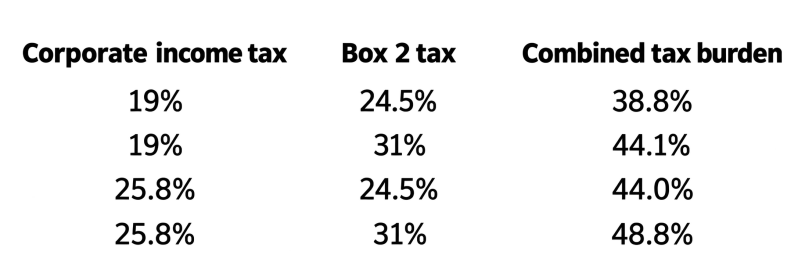
In 2026, the corporate income tax rates for a BV are 19% on profits up to €200,000 and 25.8% on profits above that amount. When the BV distributes a dividend to its shareholder, the distribution is subject to Box 2 tax.
In 2026, the Box 2 rate is 24.5% on income up to €68,843 and 31% on income above that threshold. Since 2025, Box 2 income has also reduced the general tax credit (algemene heffingskorting).
The table below assumes that all profits remaining after corporate income tax are distributed in full and taxed at the applicable Box 2 rate.
5. Box 3 or a BV: comparing tax rates alone is not enough
The choice between investing in Box 3 and investing through a BV cannot be made simply by comparing their respective tax rates.
One important advantage of investing through a BV is that Box 2 tax generally only arises when profits are distributed to the shareholder or when the shares are disposed of. As long as profits remain in the BV, Box 2 tax can generally be deferred.
Both Box 2 and Box 3 income form part of aggregate income (verzamelinkomen) and can therefore result in a lower general tax credit and affect other income-dependent schemes. The difference is that Box 3 income is taken into account annually, whereas a BV shareholder can, in principle, decide when and how much dividend to distribute. This gives the shareholder some control over the timing of Box 2 taxation and its effects on income-dependent arrangements.
Examples of such income-dependent schemes include childcare benefit, the child-related budget, healthcare benefit and the elderly person’s tax credit.
Deferring Box 2 taxation can also affect investment returns. As long as profits remain in the BV and are reinvested, the amount that would otherwise have been paid in Box 2 tax remains available for investment. Additional returns may be earned on that extra capital. However, the Box 2 tax liability does not disappear: it arises later when dividends are distributed or shares are disposed of.
6. Worked example: Box 3 versus a BV
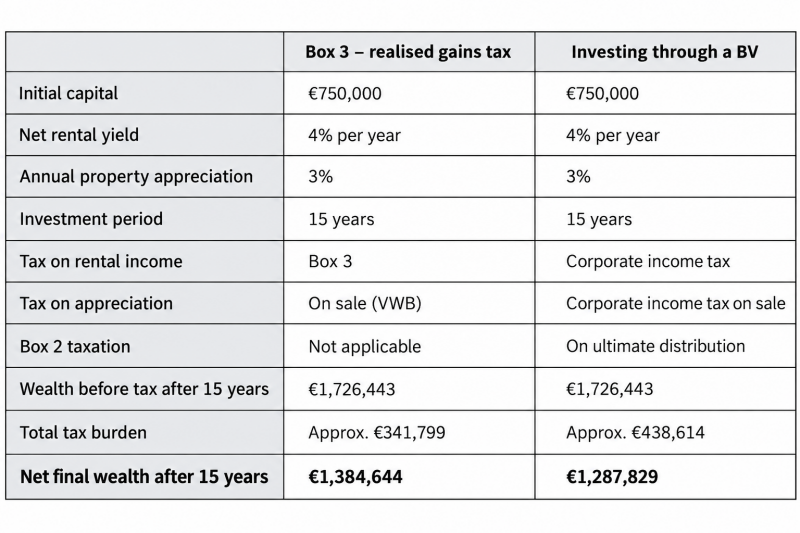
Assume that Thijs (aged 41) has €750,000 available to invest in rental property. He wants to know whether he would be better off holding the property privately in Box 3 or through a BV.
The example assumes a net annual rental yield of 4% and an annual increase in the value of the property of 3%. The property is held for 15 years and is then sold. Rental income increases over the investment period in line with the property’s increase in value.
For Box 3, the example assumes the capital gains tax on realisation (VWB) that, under the current legislative proposal, will apply to real estate from 2028.
On these assumptions, the net final wealth after 15 years is approximately €96,800 higher under Box 3 than when investing through a BV.
This does not mean that Box 3 is more favourable in every situation. The comparison is highly sensitive to factors including investment returns, capital appreciation, the investment period and the tax rates applicable throughout that period.
This worked example assumes no investment return on rental income remaining after tax. Accordingly, the difference in final wealth is caused solely by the difference in taxation. In practice, deferral of tax within a BV can also have a return-enhancing effect where available funds are reinvested.
It is further assumed that Thijs initially has €750,000 and decides at the outset whether the property will be acquired privately or through the BV. Transaction costs and real estate transfer tax on the initial purchase have been disregarded in both scenarios.
7. Other factors affecting the choice
Based on the worked example above, investing in Box 3 produces a better long-term result. This does not, however, mean that Box 3 should be preferred in every case.
When investing through a BV, Box 2 taxation may be deferred for a long period. The returns earned within the BV are subject to corporate income tax, but as long as the remaining profits are not distributed as dividends, no Box 2 tax is payable on them. The amount of personal income tax thus deferred can be reinvested within the BV.
Reinvestment reserve
In the case of real estate in particular, a BV may also offer advantages through the possibility, subject to conditions, of establishing a reinvestment reserve (herinvesteringsreserve, HIR). A HIR can defer taxation of the book profit realised on the sale of a business asset, such as investment property, if there is an intention to reinvest in another business asset.
The book profit is then not taxed immediately but is deducted from the acquisition cost of the replacement investment. The HIR therefore defers taxation and leaves more funds available for reinvestment. No comparable reinvestment reserve exists in Box 3.
The outcome of a comparison between Box 3 and a BV does not, in itself, determine whether existing assets should actually be transferred. The tax consequences of the transfer itself must also be considered, as discussed in section 8.
8. Transferring assets between private ownership and a BV
When choosing between investing in Box 3 and investing through a BV, it is important not only to identify which structure ultimately produces the more favourable tax outcome. Equally important is where the assets are currently held. Transferring assets from private ownership to a BV, or vice versa, can itself trigger taxation, which must also be taken into account.
8.1 From Box 3 to a BV
If the assets to be invested are held privately, they can be transferred to a BV. When incorporating a new BV, the assets may, for example, be contributed as share capital. In an existing BV, an additional paid-in capital contribution (share premium contribution, or agio) can also be made. Another option is to lend the assets to one’s own BV, provided that an arm’s-length interest rate is agreed.
Real estate transfer tax requires particular attention. Transferring real estate from private ownership to one’s own BV will, in principle, constitute a taxable acquisition by the BV. This applies both when the property is sold to the BV and when it is contributed as share capital or share premium.
In 2026, the real estate transfer tax rate for residential property not used as a main residence is 8%. For non-residential property, such as commercial buildings, the rate is 10.4%. A real estate transfer tax exemption may sometimes be available, for example in connection with the interaction between real estate transfer tax and VAT. This depends on the specific facts.
Under the proposed future Wwr regime, transferring existing real estate to a BV could also constitute a realisation event for capital gains accrued in Box 3. Under the current proposal, capital gains on real estate are taxed when realised.
A calculation indicating that investing through a BV would be more favourable therefore does not automatically mean that it is attractive to transfer existing property from Box 3 to the BV. Real estate transfer tax and Box 3 taxation upon realisation can play a decisive role.
8.2 From a BV to Box 3
Where the assets are already held within a BV, the tax consequences of transferring them into private ownership must likewise be considered.
One option is the repayment of share capital. Subject to certain conditions, this can be done without Box 2 taxation insofar as the repayment does not exceed the tax acquisition cost of the shares. A tax-free repayment of share capital is, however, subject to formal requirements.
Another option is a dividend distribution. A dividend distribution triggers Box 2 tax. As a result, not all the assets held within the BV will subsequently be available for investment in Box 3.
Finally, the shareholder may borrow money from their own BV. The loan must be entered into on arm’s-length terms, and the excessive borrowing rules for shareholders borrowing from their own company may need to be taken into account.
The decision therefore depends not only on where the highest net final wealth can be achieved, but also on where the investable assets are currently held and what taxation would be triggered by moving them to the alternative structure.
Naturally, liquidity requirements may also be an important consideration.
9. Conclusion
The above analysis shows that the choice between Box 3 and investing through a BV cannot always be answered unequivocally without taking other considerations into account.
The outcome depends, among other things, on the type of investment, the anticipated direct return and capital appreciation, the investment period, the possibility of retaining profits within the BV and where the assets are currently held.